

Welcome back!
This week’s Caffeine Question is this. What is your go to rainy day beverage? I love curling up on the couch with a warm cup of tea during a rainy day. It’s just so relaxing. Comment below!
Have you ever planned a fun field trip for your students, only to have it canceled due to finances, weather, etc.? Those days just seem to be so depressing, right? Well don’t worry, today we are beginning a series dedicated to finding ways to bring a historical field trip to the classroom! No travel or buddy system required.
We’ve all experienced a day where the hope to take a trip to a history museum was postponed due to school finances, bad weather, or recently….a pandemic. However, many museums around the world have found ways to fix this issue in order to broaden their own accessibility. This brings us to the topic of digital museum tours. Many museums around the world have created in-depth tours dedicated to giving online visitors an immersive and engaging experience that is next-level to in-person tours. During the early days of the Covid-19 pandemic, I began to investigate fun museums that I could watch while taking breaks in between classes or during a lunch break from work. These ranged from tours, virtual exhibits, to livestream tours with a tourguide. Now, why are these virtual tours a thing, and why do we need them?
Museums, as we know, can be found all around us and some can be too far away, or too pricey. As a result, the accessibility we would see from these museums without virtual tours can be very limiting. By creating a digitally immersive tour, museums are able to offer their exhibits worldwide for those who cannot travel or afford to visit. One of the best examples of these digital tours can be seen with the Museum of the World through the British Museum in London.
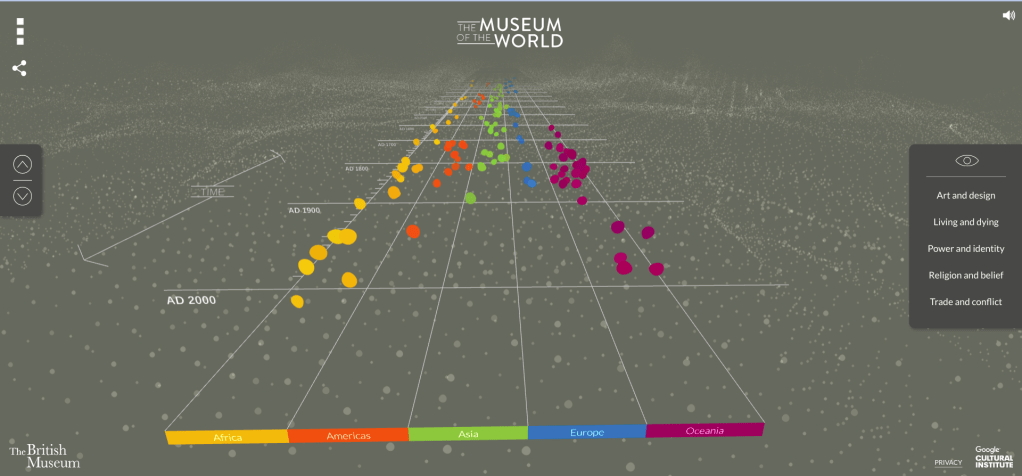
With the use of simple controls and sound effects, the Museum of the World shows a timeline of world for students to travel through through the incorporation of theses such as: arts, culture, trade, society, and life at the time. After clicking one of the dots, students are able to read or listen about the artifact they chose, its location, and its importance to history. Although this example is not the British Museum itself, it does show a virtual museum for students to travel through and learn about fun and interesting exhibits within the museum itself.
If you are looking for a museum tour that you can “walk through,” The J. Paul Getty Museum in Los Angeles is a great example.
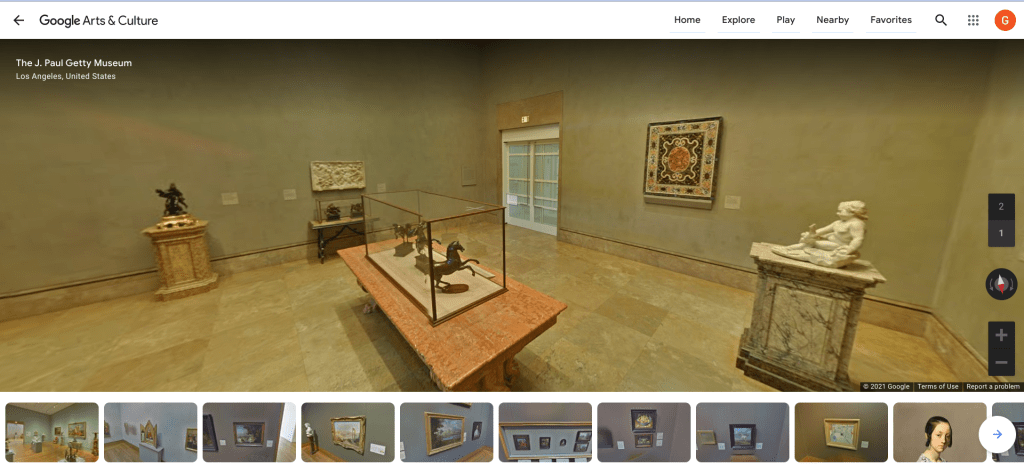
After a quick search through Google’s Arts & Culture section, this museum allows you to actually walk through the museum and look at the exhibits. Along with this feature, you are able to click on each item below the walk through section, in order to cover everything within the rooms.
Another example is the National WWII Museum in New Orleans. For $100, you can book an interactive and virtual tour through the musuem. This project was created as a form of distance learning for students that allows them to engage during museum tours while also exploring a museum they may not be able to travel to.

These tours are great ways to give students a non-travel field trip day that keeps them engaged and interested in history, as they walk through or watch through virtual museums. Thanks to many museums following this trend, the gap between history and the public begins to dissipate! Whether it is a simple run through of a museum as a class or individual, group designed museum tours, discussions on a specific area, etc. students will enjoy every second while they learn more about history.
Any questions or comments relating to our topic this week? Be sure to comment below or message via the contact page!
Until next time!
 THE CAFFEINATED HISTORIAN
One thought on “Rainy Field Trips & Earl Grey Tea: Digital Museum Tours”